Can You Trust God's Word? Is it Reliable and Uncorrupted?
A Short Lesson in Apologetics

Torrey Burton
March 2, 2026
In 1 Peter 3:15 we are directed: "But in your hearts revere Christ as Lord. Always be prepared to give an answer to everyone who asks you to give the reason for the hope that you have. But do this with gentleness and respect, keeping a clear conscience, so that those who speak maliciously against your good behavior in Christ may be ashamed of their slander."
I believe this is great encouragement for every believer in Christ to learn the discipline of apologetics: "the discipline of providing a reasoned defense and justification of faith"
There are multiple avenues of apologetics (natural/classical, evidential/historical, presuppositional, cumulative, etc.), but at its core, each one is used to answer challenging questions from unbelievers and defend the faith. You'll also find that becoming stronger in apologetics will encourage and strengthen your own faith.
This past weekend I encountered the common question posed by unbelievers and believers alike:
Is the Bible reliable? How do we know that man hasn't corrupted God's Word as time has passed?
STOP and THINK
If someone asked you this question: what would you answer?
Do you trust that God's Word remains reliable and uncorrupted by man?
Let's take a few minutes to learn some apologetics and strengthen/encourage your faith!
Short Answer: Yes. God's Word remains reliable. It is uncorrupted by man. Even though much time has passed since the original writings, God's Word has not changed.
Now let's use some evidential/historical apologetics to prove that answer.
For ANY ancient document, there are two tests to consider:
-
-
The time gap of the oldest extant manuscripts (MS/MSS) we have available to when the original autographs documents were handwritten. The smaller the gap, the better. **It is important to note that "we do not possess the autograph of even one ancient document, [therefore] this test best determines transmissional accuracy for any ancient document." - Christian Research Institute
-
The number of oldest extant manuscripts compared to the number and earliness of extant manuscripts of other ancient documents (think of authors like Homer, Aristotle, Plato, Pliny, etc). The more copies, the better.
-
How does the New Testament fair in these two tests?
-
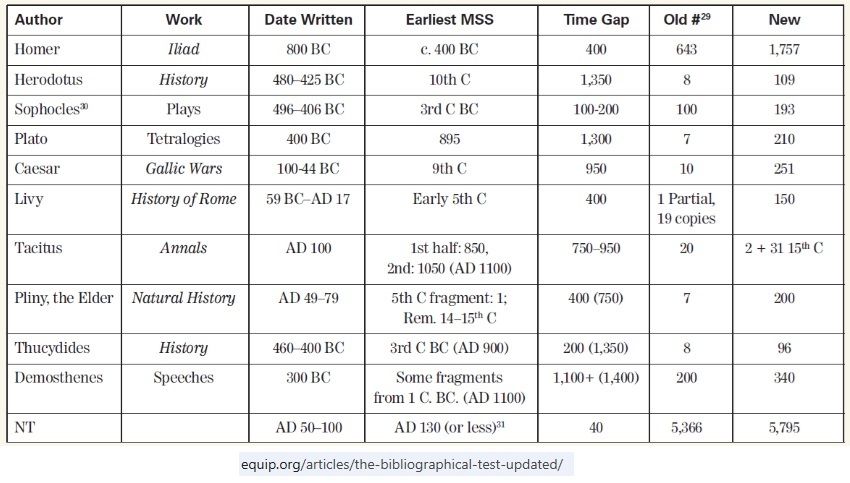
Time Gap: 40! The original autographs were in AD 50-100, the oldest extant manuscripts (MS/MSS) are from AD 130 (or less).
-
Number of extant manuscripts: 5,795!
In the attached chart from the Christian Research Institute, you can see the New Testament FAR SURPASSES every other ancient document. It has the SMALLEST time gap and an EXCESSIVE number of extant manuscripts.
AND - NOT ONLY does the New Testament cream the competition in these two tests, BUT it also has a secret weapon: TWO OTHER FACTORS in it's favor!
-
The number of translations into other languages. The New Testament has OVER 17,974 manuscripts in other languages (Armenian, Ethiopian, Latin, Slavic, etc.)
-
Quotations from the writings of the early church fathers. Early church fathers quoted Scripture in sermons, commentaries, and treatises ("a comprehensive, scholarly, secondary source that provides in-depth analysis, commentary, and context on a specific, narrow area of law.")
"These citations [are so extensive] that if all other sources of our knowledge of the New Testament were destroyed, [the writings of the early church fathers] would be sufficient alone for the reconstruction of practically the ENTIRE New Testament." - Christian Research Institute

